How to Turn Your Interests Into Meaningful Community Action


How to Turn What You Care About Into Meaningful Community Action
Many people care deeply about issues affecting their communities, but knowing what to do next can be difficult.
You might follow an issue online, read articles, attend an event, or have conversations with friends and colleagues. But awareness is only the beginning. The next step is finding a practical way to turn that interest into meaningful community action.
Community action does not always require a large organization, significant funding, or a major time commitment. It can begin with learning, connecting with people who share your interests, discovering organizations doing relevant work, and choosing an opportunity that fits your skills and circumstances.
What Is Community Action?
Community action is the process of people working individually or collectively to address issues, strengthen communities, or contribute to shared goals.
It can include:
- Volunteering
- Community projects
- Educational programs
- Mentoring
- Advocacy
- Local initiatives
- Nonprofit activities
- Public participation
- Awareness and outreach
- Supporting organizations
- Sharing knowledge and resources
The specific form of action depends on the issue and the needs of the community.
Why Do People Struggle to Turn Interest Into Action?
The gap between caring about an issue and doing something about it is often caused by practical barriers.
People may ask:
Where do I start?
An issue can be so large that identifying a first step feels difficult.
Who is already working on this?
There may be organizations doing relevant work, but people may not know how to find them.
What can I actually contribute?
Someone may assume they need specialized expertise when an organization actually needs communication, event support, research, administration, technology, or volunteers.
How much time will it require?
People often have limited time and need flexible opportunities.
How do I know whether an opportunity is relevant?
Without useful information about organizations and opportunities, it can be difficult to decide where your contribution will be most appropriate.
A structured approach can make this process easier.
Step 1: Start With an Issue, Not an Organization
Instead of immediately searching for a particular organization, begin by identifying the issue you care about.
For example, you may be interested in:
- Education
- Environmental sustainability
- Community development
- Youth opportunities
- Economic opportunity
- Public health
- Digital inclusion
- Local neighborhoods
- Arts and culture
- Civic education
Starting with the issue gives you room to explore different organizations, perspectives, and opportunities.
Step 2: Build Your Understanding
Before taking action, learn about the issue.
Look for credible educational resources and information from organizations working directly in the field.
Consider different perspectives and ask questions about the causes of the problem, the people affected, existing programs, and the approaches organizations are using.
Learning is not separate from action. It can help you make better-informed choices about where and how to contribute.
Step 3: Find People and Organizations Already Doing the Work
You do not have to solve a community problem alone.
In many cases, organizations, educators, volunteers, community leaders, and other participants are already working on the issue.
Connecting with them can help you understand what is happening on the ground and identify opportunities to contribute.
This can also prevent duplication of effort and help direct your time toward existing initiatives.
Step 4: Match Your Skills With a Community Need
One of the most useful questions you can ask is:
What can I contribute?
Your contribution does not necessarily have to be directly related to your job.
For example:
A writer may help with communications.
A designer may support visual materials.
A developer may help with technology.
A researcher may contribute research and analysis.
A teacher may support educational programs.
A student may contribute time, energy, research, or event support.
A community member with strong local knowledge may help connect organizations with residents.
Your existing skills can become useful resources when matched with an appropriate opportunity.
Step 5: Choose a Realistic Level of Participation
Sustainable involvement matters.
If you have limited availability, look for short-term or flexible opportunities.
If you want a deeper level of involvement, consider longer-term volunteering, mentoring, organizational roles, or ongoing community projects.
There is no universal amount of time that defines meaningful participation.
A realistic commitment that you can maintain is often more useful than an ambitious commitment that becomes difficult to sustain.
Step 6: Connect With Others
Community action is rarely an individual process.
Connecting with people who share an interest can help you:
- Exchange ideas
- Learn from different experiences
- Discover organizations
- Find opportunities
- Build relationships
- Collaborate on projects
- Learn new skills
These connections can also create pathways to future participation.
Step 7: Take One Concrete Action
Once you understand the issue and identify a relevant opportunity, choose one action.
It could be:
- Registering for a course
- Attending an event
- Contacting an organization
- Signing up to volunteer
- Joining a community group
- Participating in a project
- Sharing a useful resource
- Offering a specific skill
- Connecting with someone working in the field
The goal is not to solve an entire problem in one step.
The goal is to move from interest to participation.
Step 8: Reflect and Continue Learning
After participating, take time to think about what happened.
What did you learn?
What surprised you?
What did the organization need?
What skills did you use?
What could you do differently next time?
Reflection can help turn individual experiences into long-term civic learning.
Over time, you can build a clearer understanding of the issues you care about and the ways you can contribute.
Creating a Personal Path From Learning to Action
A useful way to think about community involvement is as a continuous cycle:
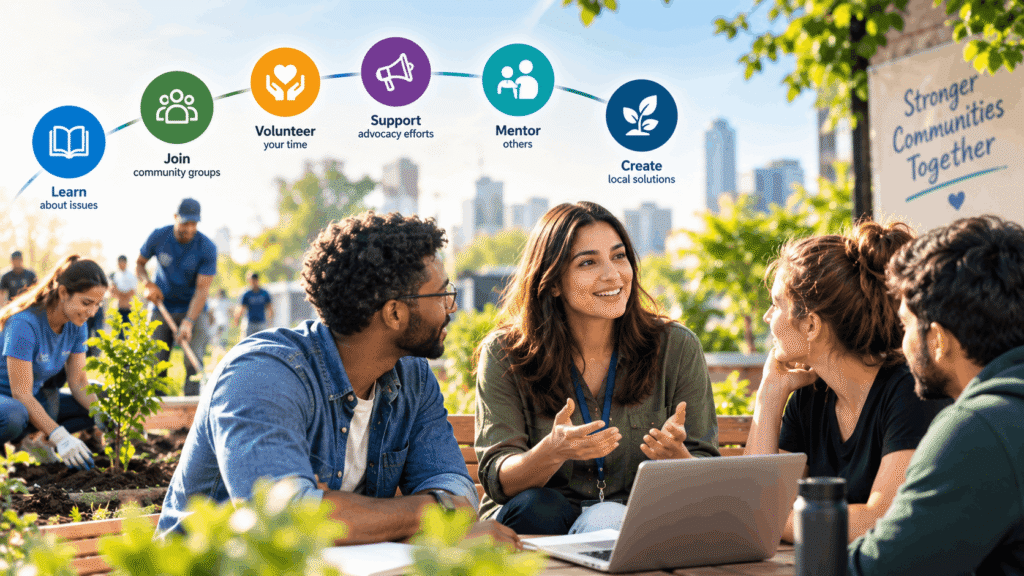
Explore → Learn → Connect → Engage → Make an Impact
First, explore an issue that interests you.
Then learn more about it.
Connect with organizations and people working in the area.
Engage through a practical opportunity.
Finally, reflect on your participation and continue building your contribution.
This approach is central to the Civic Dispatch ecosystem developed by Dispatch Network. The platform brings together interest-based learning, organizations, members, opportunities, and civic participation to help people move from understanding an issue toward meaningful engagement.
How Communities Benefit From Connected Participation
When people can more easily discover information, organizations, and opportunities, participation can become easier to navigate.
Organizations can also benefit by connecting with people who are genuinely interested in their areas of work.
This creates opportunities for stronger relationships between:
- Individuals and organizations
- Learners and educators
- Volunteers and community initiatives
- Members and mentors
- People with skills and organizations that need them
The goal is not simply to increase activity. It is to create more meaningful connections between people and the work happening in their communities.
How to Find the Right Community Opportunity
Before committing to an opportunity, consider several factors.
Does it match your interests?
You are more likely to remain engaged when the issue matters to you.
Does the organization explain its work clearly?
Look for information about the organization’s goals, activities, and community work.
Does the opportunity match your availability?
Be realistic about how much time you can contribute.
Can you use your skills?
Look for ways your knowledge or experience can provide useful support.
Will you learn something?
Good civic opportunities can provide opportunities to learn as well as contribute.
You Do Not Need to Wait Until You Are an Expert
One reason people hesitate to participate is the belief that they need extensive knowledge before getting involved.
Learning and participation can happen together.
You can begin with basic knowledge, ask questions, listen to people with experience, and gradually develop a deeper understanding.
The important thing is to approach community participation with curiosity, respect, and a willingness to learn.
Responses